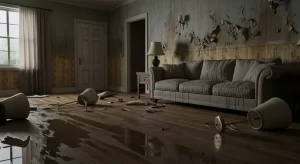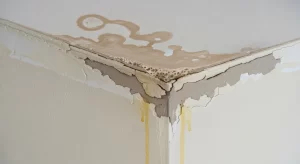

Water damage is already a stressful event for every property owner. If you are wondering why some water restoration projects fail, and some turn out perfect, here is the answer!
Some professionals follow IICRC standards, particularly the ANSI/IICRC S500 Standard for Professional Water Damage Restoration in New Jersey, and others fail to follow these guidelines.
If you have ever wondered what these standards cover and how they guide water restoration, let’s find out!
What Is the IICRC?
IICRC stands for the Institute of Inspection, Cleaning, and Restoration Certification, a non-profit organization for the inspection, cleaning, remediation, and restoration industries founded in 1972. They pinpoint the best practices and standards for:
- Water damage restoration
- Structural drying
- Mold remediation (S520)
- Fire and smoke cleanup
- Floor and carpet cleaning
- Trauma and biohazard cleanup
The important thing to understand is that the IICRC standards are evidence-based guidelines created by scientists, engineers, industrial hygienists, and restoration experts, not opinions.
Why is the ANSI/IICRC S500 Standard Important For Water Damage Restoration?
The S500 is the book and standard guideline that professionals follow for water damage restoration in New Jersey and beyond. It gives a clear, consistent process for assessing damage, removing moisture, cleaning, sanitizing, and restoring a property.
It explains how water behaves inside building materials, how microbes develop in damp spaces, and the correct way to measure moisture levels. It also provides guidance for structural repairs, HVAC cleaning, contents handling, and large-loss projects.
Keep in mind, the S500 doesn’t cover fixing the source of the water. That’s the property owner’s responsibility or another specialist’s role. Restoration begins once the cause of water damage is addressed.
Read More: How Restoration Technicians Use Moisture Meters During Cleanup?
The Three Water Categories
One of the most common questions people search for is: “What type of water damage do I have?” The IICRC S500 uses three categories:
Category 1: Clean Water
Water from supply lines, rain, or melting ice. Safe at first, but can become contaminated within hours once it seeps into materials.
Category 2: Gray Water
Water with a significant degree of chemical, biological, or physical contamination. Sources include dishwasher or washing machine discharges, toilet overflows, and hydrostatic seepage.
Category 3: Black Water
Heavily contaminated and dangerous, possibly containing pathogenic or toxigenic agents. Sources include:
- Sewage
- River or storm flooding
- Toilet backflows with fecal matter
Response for Category 3:
- PPE required
- Removal of highly porous, unsalvageable materials
- Strict cleaning and disinfection protocols
Classes of Water Damage to Determine How Much of the Building Is Wet?
Most homeowners only hear ‘Category’, but professionals also classify the extent of water damage. Class determines how many dehumidifiers, air movers, heaters, or specialty drying tools are required. The S500 defines four classes:
- Class 1 for small area, low absorption, minimal evaporation needed
- Class 2 for large areas, water absorbed into walls, subfloors, or carpets
- Class 3 for water affecting ceilings, walls, insulation, floors, and structural materials
- Class 4 for deeply saturated materials like hardwood, concrete, brick, or plaster
How the IICRC Water Damage Restoration Process Works?
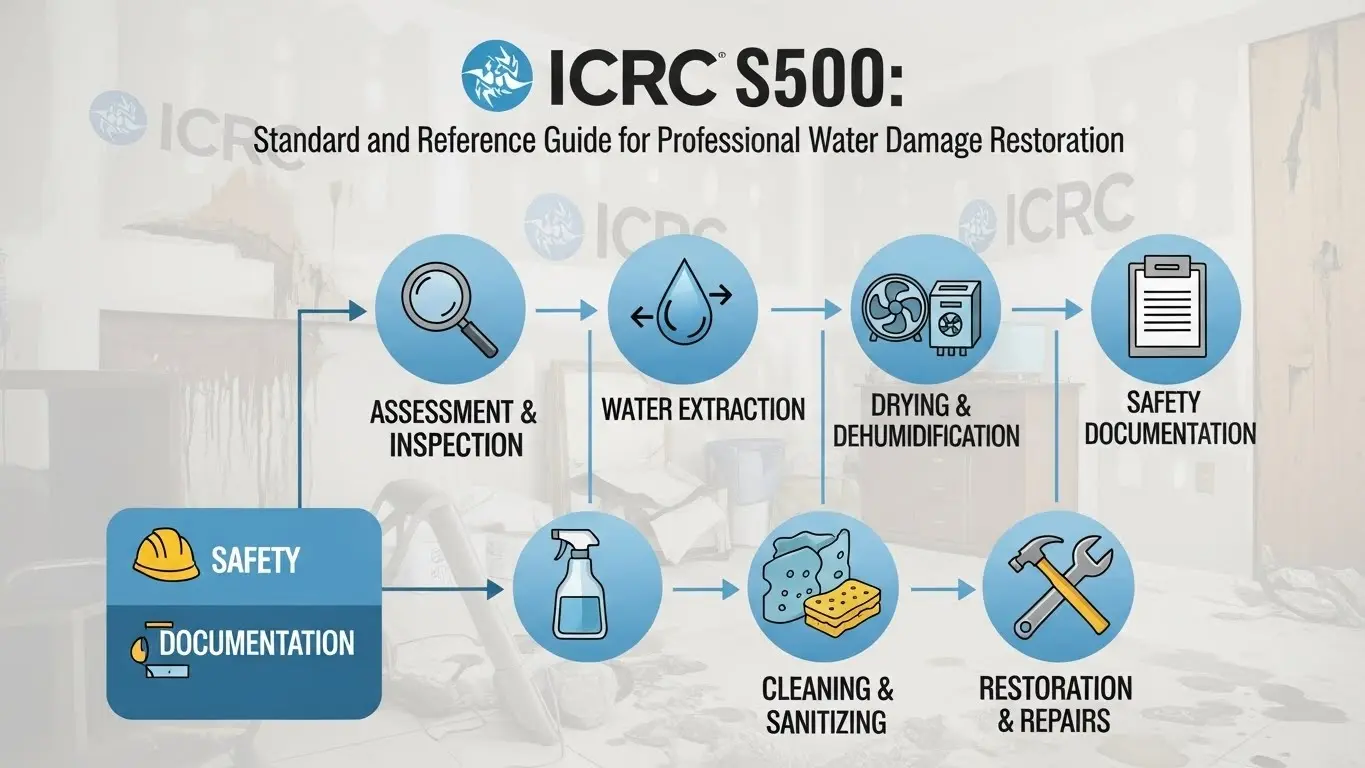
When a certified restoration team follows the guidelines S500, the workflow is clear and predictable. Here is how:
Step 1: Inspection and Moisture Assessment
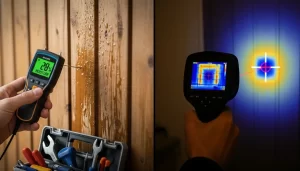
A professional starts by confirming that the source of water is no longer active. Equipment Used:
- Moisture meters
- Hygrometers
- Thermal imaging cameras
This identifies the category of water and the class of damage and creates the early documentation. Moisture readings also guide equipment placement, ensuring efficient drying.
Step 2: Fast Water Extraction
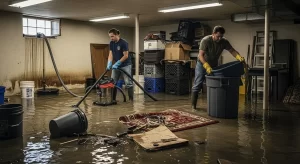
The next priority is removing as much water as fast as possible. The water damage restoration professionals bring in extractors, wet vacuums, and sometimes submersible pumps if the water is deep. Quick extraction limits structural damage, helps stop microbial growth.
Quick extraction limits structural damage and helps stop microbial growth.
Step 3: Controlled Drying and Dehumidification
When the standing water is gone, water damage technicians place air movers to push airflow across wet surfaces and encourage evaporation. They also use commercial dehumidifiers, such as refrigerant or desiccant, to remove moisture from the air and ensure a safe humidity level. Drying mats and hygrometric calculations help remove hidden moisture and prevent secondary damage.
Step 4: Cleaning, Sanitizing, and Odor Control
If the property was exposed to Category 2 or 3 water, cleaning and disinfection become essential. Teams use:
- EPA-registered antimicrobial products
- Specialized cleaning techniques for porous and nonporous materials
- Odor treatments to remove any lingering smells
Step 5: Monitoring, Adjustments, and Documentation
Drying is not a set-it-and-forget-it process; the professionals need to perform daily moisture readings, reposition equipment, and adjust the drying plan as materials respond. Every reading, photo, is important for quality control and required by most insurance carriers.
The Role of Psychrometry
What is Psychrometry
Psychrometry is the science of studying air properties and the relationship between temperature, humidity, and moisture content in the atmosphere.
What is the Role of Psychrometry
Psychrometry helps restoration technicians control drying conditions by measuring air temperature and humidity levels to optimize water damage cleanup and prevent mold growth. Certified professionals use:
- Moisture meters
- Thermal imaging cameras
- Hygrometers
- Infrared tools
- Atmospheric calculations
This ensures accurate dry-time predictions without guesswork.
What the IICRC S500 Says About Mold and Microbial Growth?
Another question people search online is: How fast does mold grow after water damage? The answer: As fast as 24–48 hours, depending on humidity and temperature.
The S500 requires:
- Controlling microorganisms with engineering controls
- Lowering humidity via dehumidification
- Removing water-damaged porous materials
- Applying antimicrobials only when appropriate
- Avoid the overuse of chemicals that could affect occupants
This standard also ties into the IICRC S520, which deals specifically with mold remediation and indoor air quality.
Why Documentation is Important for Insurance Claims?
Insurance companies depend heavily on documentation. The S500 outlines exactly what must be recorded:
- Moisture readings (initial, daily, and final)
- Atmospheric conditions
- Equipment usage and placement
- Photographs of all affected areas
- Before-and-after moisture maps
- Drying goals and proving they were met
Proper documentation reduces claim denials and ensures homeowners receive full coverage.
Why Choose an IICRC-Certified Water Damage Restoration Company?
Searching for water damage restoration near me? Hiring an IICRC-certified company ensures that only professionals handle the water damage restoration who follow industry-proven standards.
Hiring an IICRC-certified company guarantees:
- Experts trained in building science, psychrometrics, and drying techniques
- Documentation of every step using industry-standard software and moisture mapping tools
- Use of certified equipment like Protimeter, Tramex, and Delmhorst moisture meters
- Strict adherence to S500 and S520 standards
Certification signals accountability! These companies document every step, use the right equipment, and follow strict safety protocols.
The two core certifications are: Water Damage Restoration Technician WRT and Applied Structural Drying ASD. Professionals with both are trained to handle the drying process efficiently.
Book Industry-Approved Water Damage Restoration Services in NJ
Water damage restoration service is not just about drying a wet space but about understanding the science of moisture, building materials, airflow, contamination, and microbial risk. The IICRC S500 Standard brings all of that together into one trusted framework.
Don’t guess in case of water damage; trust the certified professionals at NSH Home Services who make it happen as per industry standards. Contact us now!